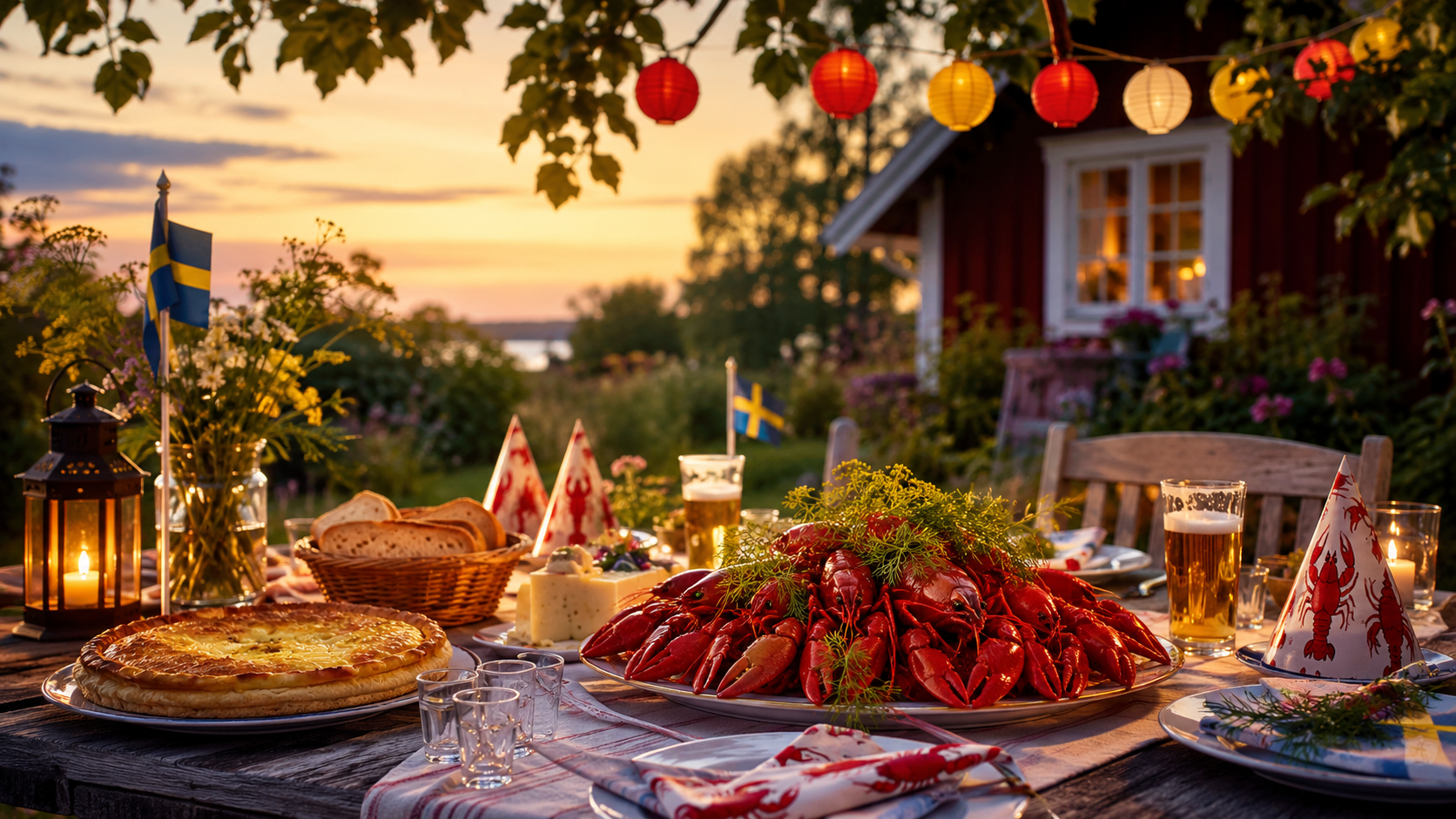
If you spend time in Sweden in August, you may hear people talking about kräftor, snaps, dill and kräftskiva. These words belong to one of Sweden’s most beloved late-summer traditions: the Swedish crayfish party.
A kräftskiva is a festive gathering where people eat crayfish, drink snaps, sing traditional drinking songs and enjoy the final weeks of summer together. It is more than just a meal. For many Swedes, it is a social ritual full of humour, nostalgia, food, music and national identity.
Today, kräftskiva is strongly associated with Swedishness. The table is often decorated with paper lanterns, party hats, napkins, crayfish motifs and sometimes Swedish flags. The food also follows tradition: ideally, there should be crayfish, dill, snaps, bread, cheese and the famous Västerbottenpaj, a rich cheese pie often served at Swedish crayfish parties. Visit Sweden also describes the crayfish party as a classic Swedish tradition connected with August, food, songs and festive table decorations.
What is Kräftpremiären?
The word Kräftpremiären refers to the traditional opening of the crayfish season. Historically, Swedish crayfish fishing was restricted for part of the year, and the season began in August. Visit Sweden notes that the traditional crayfish party season began on the first Wednesday of August, connected to the historic ban on crayfish fishing between November and 7 August.
Although the old regulation is no longer followed in the same way today, the seasonal feeling remains very strong. Crayfish can now be bought at other times of year, and imported crayfish are also widely available, but many Swedes still associate crayfish parties with August and the end of summer. Sweden.se also highlights that, although imported crayfish can now be bought all year round, many Swedes still keep the seasonal tradition.
In other words, kräftskiva is not only about what is on the plate. It is about timing, atmosphere and tradition.
A tradition from the 20th century
The modern Swedish crayfish party became popular during the 20th century. The Swedish word kräftskiva itself is often linked to the 1930s, although earlier crayfish-and-drink rituals existed before that. Visit Sweden explains that the term kräftskiva was coined in the 1930s and is believed to be connected to an older 19th-century bourgeois crayfish ritual called kräftsupa.
The word itself is interesting for Swedish learners:
kräfta = crayfish
kräftor = crayfish, plural
skiva = disc / slice / panel or board (it refers to the word tabletop)
So kräftskiva means a crayfish party.
This is a good example of how Swedish compound words often carry cultural meaning. Once learners understand the parts of the word, the whole tradition becomes easier to remember.
What do Swedes eat at a crayfish party?
The star of the table is, of course, the crayfish. Traditionally, crayfish are boiled in water with salt, sugar and plenty of dill. Some recipes also include beer in the cooking liquid, depending on family tradition and personal taste. Visit Sweden’s German-language tradition page also describes the cooking liquid as including salt, sugar, dill and beer.
A typical kräftskiva table may include:
| Swedish | English |
|---|---|
| kräftor | crayfish |
| dill | dill |
| snaps | schnapps / aquavit |
| bröd | bread |
| ost | cheese |
| Västerbottenpaj | Västerbotten cheese pie |
| kryddad ost | spiced cheese |
| öl | beer |
Västerbottenpaj is especially popular. It is a savoury cheese pie made with Västerbotten cheese, a Swedish cheese with a rich and distinctive flavour. Visit Stockholm also lists Västerbotten cheese, bread and snaps among the customary elements of a crayfish party.
Snaps and snapsvisor: singing at the table
A crayfish party is not only about food. It is also about singing. One of the most characteristic parts of the evening is the snapsvisa, a short drinking song sung before drinking snaps.
The plural form is snapsvisor.
For Swedish learners, this word is useful because it combines two important cultural elements:
snaps = schnapps / aquavit
visa = song
snapsvisa = drinking song
snapsvisor = drinking songs
At a kräftskiva, people may sing several snapsvisor during the meal. These songs are often short, funny and easy to join in, even for those who do not know all the words perfectly. They help create the relaxed, playful atmosphere that makes kräftskiva such a memorable tradition. Visit Sweden also connects the crayfish party with snaps and traditional songs.
Why is kräftskiva so Swedish?
Kräftskiva has become one of the celebrations that many people associate with Swedish identity. The details may sound simple — crayfish, dill, cheese pie, snaps and songs — but together they create a recognisable cultural scene.
There is something very Swedish in the combination of late-summer nature, seasonal food, informal humour and carefully preserved tradition. The party often takes place outdoors or in a summer house, and the decorations can be playful rather than elegant: paper hats, lanterns, bibs and crayfish motifs are all part of the atmosphere.
The tradition also reflects a broader Swedish love of seasonal celebrations. Just as Midsommar belongs to early summer, kräftskiva belongs to August: a way to enjoy the season before autumn arrives.
Useful Swedish words connected to kräftskiva
A cultural topic like kräftskiva is a great way to learn practical Swedish vocabulary. Here are some useful words for language learners:
| Swedish | English |
|---|---|
| kräfta | crayfish |
| kräftor | crayfish, plural |
| kräftskiva | crayfish party |
| kräftpremiär | opening of the crayfish season |
| att äta kräftor | to eat crayfish |
| att dricka snaps | to drink snaps |
| snapsvisa | drinking song |
| snapsvisor | drinking songs |
| dill | dill |
| ost | cheese |
| paj | pie |
| Västerbottenpaj | Västerbotten cheese pie |
| svensk tradition | Swedish tradition |
| fest | party / celebration |
| sensommar | late summer |
A few simple example sentences:
Vi ska gå på kräftskiva i augusti.
We are going to a crayfish party in August.
De äter kräftor och sjunger snapsvisor.
They are eating crayfish and singing drinking songs.
Vill du ha mer Västerbottenpaj?
Would you like more Västerbotten cheese pie?
Kräftskivan är en svensk tradition.
The crayfish party is a Swedish tradition.
Language insight: Swedish compound words
Swedish learners often notice that Swedish uses many compound words. Kräftskiva is a perfect example. Instead of using a long phrase, Swedish can combine words into one compact expression.
Other examples from this topic include:
kräftpremiär = crayfish season opening
snapsvisa = drinking song
Västerbottenpaj = Västerbotten cheese pie
sensommarfest = late-summer party
Learning compound words is very useful because it helps students understand longer Swedish words more easily. When you recognise the smaller parts, the meaning often becomes clear.
What can language learners learn from Swedish traditions?
Learning a language is not only about grammar and vocabulary. Culture gives words a real-life setting. A word like kräftskiva is difficult to understand fully if we only translate it as “crayfish party”. It carries a whole world of associations: August evenings, friends around the table, dill-scented crayfish, songs, laughter and the feeling of late summer in Sweden.
For adult learners, cultural topics can make language learning more memorable. Instead of studying isolated words, students learn vocabulary through real situations — food, celebrations, invitations, table conversations and seasonal customs.
Swedish courses at InterLanguage
At InterLanguage Language Centre, Swedish can be studied online or in the classroom, in individual or small-group courses. Lessons can include grammar, pronunciation and vocabulary, but also cultural topics that help learners understand how Swedish is used in real life.
If you would like to learn Swedish step by step, it is worth exploring not only the language, but also the traditions, everyday habits and cultural references that make Swedish communication feel natural.
A tradition like kräftskiva shows exactly why language and culture belong together. When you understand the story behind the word, you remember the word more easily — and you get one step closer to the Swedish way of life.