Surströmmingsfest: Sweden’s Most Divisive Food Tradition

Surströmmingsfest: Sweden’s Fermented Herring Tradition Explained

Few Swedish food traditions divide opinion quite like surströmming. Being invited to a surströmmingsfest can be seen as a warm and memorable gesture — but actually eating surströmming is a different matter. For some, it is a beloved northern delicacy. For others, it is one of the most challenging food experiences Sweden has to offer.

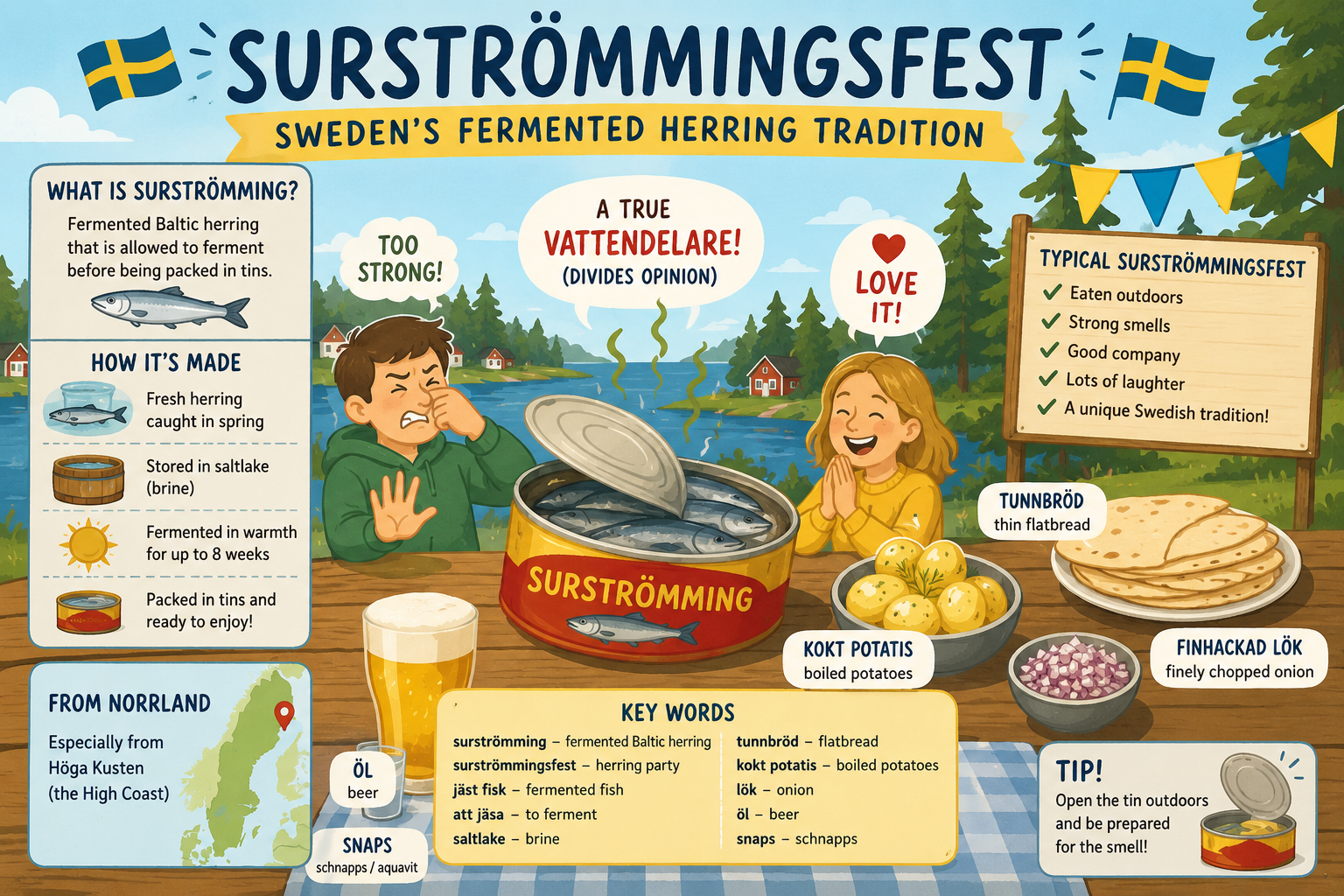
Surströmming is often described as one of Sweden’s most unusual traditional foods. In simple terms, it is fermented Baltic herring. The fish is allowed to ferment before it is packed into tins, giving it its famously strong smell and distinctive flavour.

surströmmingsfest is therefore not just a meal. It is a cultural event, a conversation starter and, for many language learners, a fascinating window into Swedish food history, regional identity and vocabulary.

What is surströmming?

The Swedish word surströmming consists of two parts:

sur = sour
strömming = Baltic herring

So the word can be understood as soured or fermented herring.

Surströmming is made from Baltic herring that has gone through a fermentation process. Fermentation, or jäsning in Swedish, has been used for thousands of years as a way to preserve food. Long before modern refrigerators and freezers, people needed methods to make food last longer. Salting, drying, smoking and fermenting were all important techniques.

Surströmming became especially valuable because of its long shelf life. Historically, this made it useful in situations where food needed to be stored and transported, including military contexts.

Today, surströmming is closely associated with northern Sweden, especially Norrland, with production centred around the High Coast area, known in Swedish as Höga kusten.

Why is surströmming so controversial?

Surströmming is a true vattendelare — a Swedish word that literally means “watershed”, but is often used to describe something that strongly divides opinion.

Some people appreciate surströmming as a traditional delicacy with deep cultural roots. Others find the smell extremely difficult to handle. Even many Swedes have never tried it, and among those who have, reactions can be very different.

This is one of the reasons why a surströmmingsfest can be such a memorable social event. It is not only about taste. It is about courage, humour, curiosity and tradition. For foreign visitors and Swedish learners, it is often one of those cultural experiences people remember for a long time.

How is surströmming made?

Surströmming is essentially fermented strömming, or Baltic herring. The fish is usually caught during the spring spawning season. After being caught, it is placed in saltlake, meaning brine — water saturated with salt — in large open wooden containers.

After a few days, the herring is transferred into a new brine, this time with a lower amount of salt. This is important because the fish must be preserved, but the fermentation process also needs to continue.

The fermentation itself requires warmth. Traditionally, the barrels may be placed in sunlight, allowing the process to develop under the right conditions. When the herring begins to ferment, the barrels are kept at around 15–18°C for up to eight weeks.

After this, the fish is packed into metal tins and distributed across Sweden — and sometimes even to other parts of the world.

What do people eat with surströmming?

Surströmming is rarely eaten on its own. It is usually served with simple but important accompaniments that balance the strong flavour of the fish.

A traditional surströmmingsfest often includes:

SwedishEnglish
surströmmingfermented Baltic herring
tunnbrödthin flatbread
kokt potatisboiled potatoes
finhackad lökfinely chopped onion
ölbeer
snapsschnapps / aquavit

The most common way to eat surströmming is with tunnbröd, boiled potatoes and finely chopped onion. Many people make a kind of open or rolled flatbread sandwich, where the strong fish is combined with milder ingredients.

The meal is often washed down with beer, and sometimes with snaps, a traditional Scandinavian spirit often served at festive meals.

Surströmmingsfest: more than just fermented fish

surströmmingsfest is a gathering where people come together to eat surströmming in a social setting. The atmosphere is often informal, humorous and curious. Since the smell of surströmming is very strong, the meal is often enjoyed outdoors.

For many people, the experience is just as important as the food itself. Opening the tin, reacting to the smell, preparing the tunnbröd, tasting the first bite and sharing the moment with others are all part of the tradition.

This is why being invited to a surströmmingsfest can feel special. It is a way of being included in a very distinctive part of Swedish food culture — even if not everyone becomes a fan of the dish.

Useful Swedish words connected to surströmming

Food traditions are excellent for language learners because they connect vocabulary with real cultural situations. Here are some useful Swedish words from the world of surströmming:

SwedishEnglish
surströmmingfermented Baltic herring
surströmmingsfestfermented herring party
strömmingBaltic herring
jäst fiskfermented fish
att jäsato ferment
jäsningfermentation
konservtin / canned food
saltlakebrine
tunnbrödthin flatbread
kokt potatisboiled potatoes
lökonion
finhackad lökfinely chopped onion
ölbeer
snapsschnapps / aquavit
Norrlandnorthern Sweden
Höga kustenthe High Coast
vattendelaresomething that divides opinion

A few simple example sentences:

Surströmming är jäst fisk.
Surströmming is fermented fish.

Vi blev bjudna på surströmmingsfest.
We were invited to a surströmming party.

Man äter ofta surströmming med tunnbröd och potatis.
Surströmming is often eaten with flatbread and potatoes.

Surströmming är en riktig vattendelare.
Surströmming really divides opinion.

Language insight: the word “vattendelare”

One particularly useful word in this topic is vattendelare. Literally, it means “watershed” or “water divider”. In everyday Swedish, however, it can also be used figuratively for something that separates people into different camps.

Surströmming is a perfect example of a vattendelare. Some people love it, some strongly dislike it, and many are simply curious to try it once.

For Swedish learners, this word is useful far beyond food. It can also be used when talking about films, politics, fashion, cultural debates or any topic that strongly divides opinion.

What does surströmming teach us about Swedish culture?

Surströmming may seem unusual at first, but it tells us a lot about Swedish history and regional identity. It reminds us of older methods of preserving food, of the importance of fish in Nordic cuisine, and of the strong connection between food and place.

The tradition is especially connected to northern Sweden, where nature, fishing and preservation methods have long shaped everyday life. Today, surströmming is not eaten because people have no other way to preserve fish. It is eaten because it carries tradition, memory and identity.

It also shows something important about Swedish humour. A surströmmingsfest often includes laughter, curiosity and shared reactions. The strong smell is not hidden — it is part of the experience.

Learning Swedish through food traditions

Learning Swedish becomes more meaningful when words are connected to culture. A word like surströmmingsfest is difficult to understand fully if we translate it only as “fermented herring party”. Behind the word there is a whole cultural scene: northern Sweden, fermentation, flatbread, potatoes, onion, beer, snaps and strong opinions.

For language learners, topics like this make vocabulary easier to remember. Instead of learning isolated words, students learn them through real-life situations: invitations, food, celebrations, regional traditions and conversations around the table.

If you would like to learn Swedish step by step, explore our Swedish courses.
Kräftskiva: The Swedish Crayfish Party and a Delicious August Tradition

If you spend time in Sweden in August, you may hear people talking about kräftor, snaps, dill and kräftskiva. These words belong to one of Sweden’s most beloved late-summer traditions: the Swedish crayfish party.

A kräftskiva is a festive gathering where people eat crayfish, drink snaps, sing traditional drinking songs and enjoy the final weeks of summer together. It is more than just a meal. For many Swedes, it is a social ritual full of humour, nostalgia, food, music and national identity.

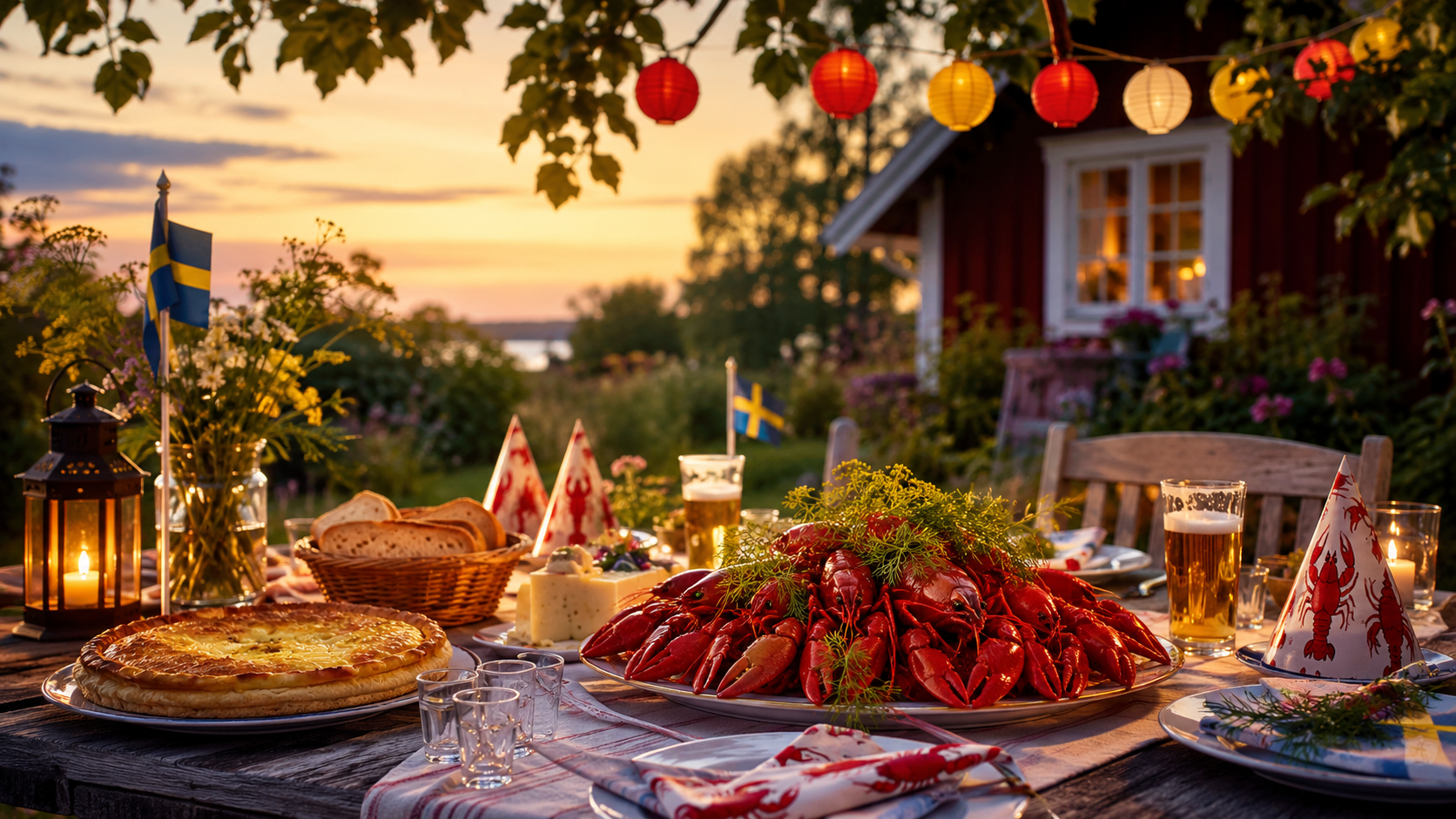
Today, kräftskiva is strongly associated with Swedishness. The table is often decorated with paper lanterns, party hats, napkins, crayfish motifs and sometimes Swedish flags. The food also follows tradition: ideally, there should be crayfish, dill, snaps, bread, cheese and the famous Västerbottenpaj, a rich cheese pie often served at Swedish crayfish parties. Visit Sweden also describes the crayfish party as a classic Swedish tradition connected with August, food, songs and festive table decorations.

What is Kräftpremiären?

The word Kräftpremiären refers to the traditional opening of the crayfish season. Historically, Swedish crayfish fishing was restricted for part of the year, and the season began in August. Visit Sweden notes that the traditional crayfish party season began on the first Wednesday of August, connected to the historic ban on crayfish fishing between November and 7 August.

Although the old regulation is no longer followed in the same way today, the seasonal feeling remains very strong. Crayfish can now be bought at other times of year, and imported crayfish are also widely available, but many Swedes still associate crayfish parties with August and the end of summer. Sweden.se also highlights that, although imported crayfish can now be bought all year round, many Swedes still keep the seasonal tradition.

In other words, kräftskiva is not only about what is on the plate. It is about timing, atmosphere and tradition.

A tradition from the 20th century

The modern Swedish crayfish party became popular during the 20th century. The Swedish word kräftskiva itself is often linked to the 1930s, although earlier crayfish-and-drink rituals existed before that. Visit Sweden explains that the term kräftskiva was coined in the 1930s and is believed to be connected to an older 19th-century bourgeois crayfish ritual called kräftsupa.

The word itself is interesting for Swedish learners:

kräfta = crayfish
kräftor = crayfish, plural
skiva = disc / slice / panel or board (it refers to the word tabletop)

So kräftskiva means a crayfish party.

This is a good example of how Swedish compound words often carry cultural meaning. Once learners understand the parts of the word, the whole tradition becomes easier to remember.

What do Swedes eat at a crayfish party?

The star of the table is, of course, the crayfish. Traditionally, crayfish are boiled in water with salt, sugar and plenty of dill. Some recipes also include beer in the cooking liquid, depending on family tradition and personal taste. Visit Sweden’s German-language tradition page also describes the cooking liquid as including salt, sugar, dill and beer.

A typical kräftskiva table may include:

SwedishEnglish
kräftorcrayfish
dilldill
snapsschnapps / aquavit
brödbread
ostcheese
VästerbottenpajVästerbotten cheese pie
kryddad ostspiced cheese
ölbeer

Västerbottenpaj is especially popular. It is a savoury cheese pie made with Västerbotten cheese, a Swedish cheese with a rich and distinctive flavour. Visit Stockholm also lists Västerbotten cheese, bread and snaps among the customary elements of a crayfish party.

Snaps and snapsvisor: singing at the table

A crayfish party is not only about food. It is also about singing. One of the most characteristic parts of the evening is the snapsvisa, a short drinking song sung before drinking snaps.

The plural form is snapsvisor.

For Swedish learners, this word is useful because it combines two important cultural elements:

snaps = schnapps / aquavit
visa = song
snapsvisa = drinking song
snapsvisor = drinking songs

At a kräftskiva, people may sing several snapsvisor during the meal. These songs are often short, funny and easy to join in, even for those who do not know all the words perfectly. They help create the relaxed, playful atmosphere that makes kräftskiva such a memorable tradition. Visit Sweden also connects the crayfish party with snaps and traditional songs.

Why is kräftskiva so Swedish?

Kräftskiva has become one of the celebrations that many people associate with Swedish identity. The details may sound simple — crayfish, dill, cheese pie, snaps and songs — but together they create a recognisable cultural scene.

There is something very Swedish in the combination of late-summer nature, seasonal food, informal humour and carefully preserved tradition. The party often takes place outdoors or in a summer house, and the decorations can be playful rather than elegant: paper hats, lanterns, bibs and crayfish motifs are all part of the atmosphere.

The tradition also reflects a broader Swedish love of seasonal celebrations. Just as Midsommar belongs to early summer, kräftskiva belongs to August: a way to enjoy the season before autumn arrives.

Useful Swedish words connected to kräftskiva

A cultural topic like kräftskiva is a great way to learn practical Swedish vocabulary. Here are some useful words for language learners:

SwedishEnglish
kräftacrayfish
kräftorcrayfish, plural
kräftskivacrayfish party
kräftpremiäropening of the crayfish season
att äta kräftorto eat crayfish
att dricka snapsto drink snaps
snapsvisadrinking song
snapsvisordrinking songs
dilldill
ostcheese
pajpie
VästerbottenpajVästerbotten cheese pie
svensk traditionSwedish tradition
festparty / celebration
sensommarlate summer

A few simple example sentences:

Vi ska gå på kräftskiva i augusti.
We are going to a crayfish party in August.

De äter kräftor och sjunger snapsvisor.
They are eating crayfish and singing drinking songs.

Vill du ha mer Västerbottenpaj?
Would you like more Västerbotten cheese pie?

Kräftskivan är en svensk tradition.
The crayfish party is a Swedish tradition.

Language insight: Swedish compound words

Swedish learners often notice that Swedish uses many compound words. Kräftskiva is a perfect example. Instead of using a long phrase, Swedish can combine words into one compact expression.

Other examples from this topic include:

kräftpremiär = crayfish season opening
snapsvisa = drinking song
Västerbottenpaj = Västerbotten cheese pie
sensommarfest = late-summer party

Learning compound words is very useful because it helps students understand longer Swedish words more easily. When you recognise the smaller parts, the meaning often becomes clear.

What can language learners learn from Swedish traditions?

Learning a language is not only about grammar and vocabulary. Culture gives words a real-life setting. A word like kräftskiva is difficult to understand fully if we only translate it as “crayfish party”. It carries a whole world of associations: August evenings, friends around the table, dill-scented crayfish, songs, laughter and the feeling of late summer in Sweden.

For adult learners, cultural topics can make language learning more memorable. Instead of studying isolated words, students learn vocabulary through real situations — food, celebrations, invitations, table conversations and seasonal customs.

Swedish courses at InterLanguage

At InterLanguage Language Centre, Swedish can be studied online or in the classroom, in individual or small-group courses. Lessons can include grammar, pronunciation and vocabulary, but also cultural topics that help learners understand how Swedish is used in real life.

If you would like to learn Swedish step by step, it is worth exploring not only the language, but also the traditions, everyday habits and cultural references that make Swedish communication feel natural.

A tradition like kräftskiva shows exactly why language and culture belong together. When you understand the story behind the word, you remember the word more easily — and you get one step closer to the Swedish way of life.