
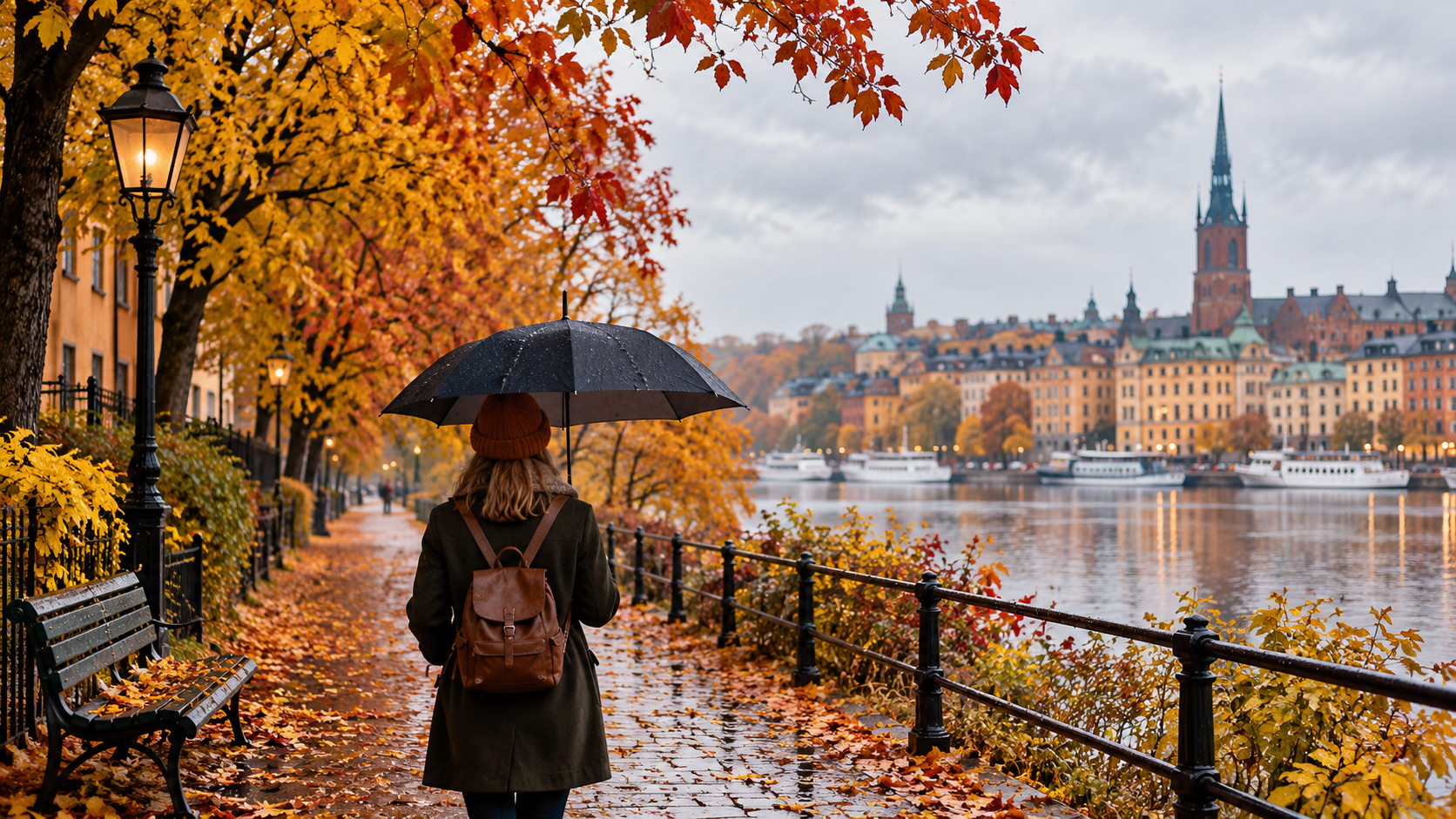
Autumn in Sweden has a special atmosphere. The days become shorter, the air feels cooler, the forests turn yellow and red, and rain becomes part of everyday conversation. Whether you are walking through a Swedish city, planning a forest walk or chatting with a colleague, weather vocabulary is extremely useful.
Swedes often talk about the weather — not necessarily because it is dramatic, but because it shapes daily life. A sunny autumn day may invite people outside for a walk, while a rainy afternoon can be perfect for coffee, candles and a warm sweater.
Autumn in Sweden
The Swedish word for autumn is höst. In September and October, Sweden changes quickly: mornings become cooler, the light becomes softer, and people return to everyday routines after the summer holidays.
Another important word is väder, which means weather.
Hur är vädret idag?
What is the weather like today?
Det är höst i Sverige.
It is autumn in Sweden.
Useful Swedish weather words
| Swedish | English |
|---|---|
| väder | weather |
| sol | sun |
| soligt | sunny |
| regn | rain |
| regnigt | rainy |
| vind | wind |
| blåsigt | windy |
| molnigt | cloudy |
| dimma | fog |
| dimmigt | foggy |
| kallt | cold |
| svalt | cool |
| milt | mild |
| grått | grey |
A few examples:
Det regnar idag.
It is raining today.
Det är molnigt.
It is cloudy.
Det blåser mycket.
It is very windy.
Autumn words in Swedish
Autumn is also about colours, nature, clothes and atmosphere.
| Swedish | English |
|---|---|
| höst | autumn |
| löv | leaves |
| träd | tree |
| skog | forest |
| promenad | walk |
| höstväder | autumn weather |
| höstfärger | autumn colours |
| mörker | darkness |
| ljus | light |
| jacka | jacket |
| halsduk | scarf |
| stövlar | boots |
| paraply | umbrella |
Example sentences:
Löven blir gula och röda.
The leaves turn yellow and red.
Vi går på promenad i skogen.
We are going for a walk in the forest.
Jag behöver en jacka idag.
I need a jacket today.
Har du ett paraply?
Do you have an umbrella?
How to describe an autumn day in Swedish
With just a few words, learners can already describe autumn weather naturally:
Det är en vacker höstdag.
It is a beautiful autumn day.
Det är grått och regnigt.
It is grey and rainy.
Det är svalt men soligt.
It is cool but sunny.
Luften är frisk.
The air is fresh.
Det blir mörkt tidigt.
It gets dark early.
A useful phrase is frisk luft, meaning fresh air.
Jag vill gå ut och få lite frisk luft.
I want to go outside and get some fresh air.
Brittsommar: the Swedish version of Indian summer
In English, people sometimes say Indian summer for an unexpectedly warm and sunny period in autumn. Swedish has its own word for this: brittsommar.
Brittsommar refers to a mild, sunny period in autumn, often associated with early October and the name day of Birgitta. It is the kind of weather that briefly makes autumn feel like summer again.
| Swedish | English |
|---|---|
| brittsommar | Indian summer / mild sunny autumn period |
| milt väder | mild weather |
| soligt väder | sunny weather |
| höstsol | autumn sun |
Vi hade brittsommar i oktober.
We had an Indian summer in October.
Swedish small talk about the weather
Weather is a safe and useful topic for small talk in Swedish. You can use it with neighbours, colleagues, classmates or people you meet in everyday situations.
Fint väder idag.
Nice weather today.
Det är riktigt höstväder.
It is real autumn weather.
Det regnar igen.
It is raining again.
Hoppas det blir sol imorgon.
I hope it will be sunny tomorrow.
These short phrases are natural, practical and easy to reuse.
Learning Swedish through seasons
Learning vocabulary through the seasons is effective because the words are connected to real life. Autumn gives learners many useful themes: weather, clothes, nature, daily routines, light and darkness.
Try learning short phrases instead of isolated words:
regnigt väder = rainy weather
en kall morgon = a cold morning
en vacker höstdag = a beautiful autumn day
frisk luft = fresh air
varma kläder = warm clothes
If you would like to improve your Swedish step by step, explore our Swedish courses.